
You charged the tenant for damage.
The tenant disputed it.
You were confident you were right.
The adjudicator ruled against you anyway.
Not because the damage was not real. Because you could not prove it was the tenant’s fault. Without deposit disputes documentation that clearly shows the property’s condition at the start of the tenancy, that is exactly the position you end up in.
Deposit disputes documentation is the difference between winning and losing a claim you were certain about. This guide explains why documentation fails, what it needs to look like to hold up, and how to build a collection process that protects you before a dispute ever starts.
Why Landlords Lose Deposit Disputes Documentation Cases
The most common assumption landlords make about deposit disputes documentation is that evidence means photos.
Photos help. But photos without context, without a dated, signed inventory that establishes what the property looked like at check-in, are rarely enough on their own.
When a deposit dispute goes to adjudication, the burden of proof sits with the landlord or agent. The adjudicator starts from the assumption that the deposit belongs to the tenant. Your job is to demonstrate, with clear deposit disputes documentation, that a deduction is reasonable and justified.
If your evidence is incomplete, inconsistent, or cannot be clearly tied to the start of the tenancy, the claim weakens regardless of what actually happened.
What adjudicators actually look for in deposit disputes documentation
According to guidance from the Tenancy Deposit Scheme, the strongest evidence in any deposit dispute is a thorough check-in report and a matching check-out report. These documents establish a baseline, the condition of the property when the tenant moved in, and a comparison point at the end.
Without a check-in report, there is no baseline. Without a baseline, there is no way to prove that the damage occurred during the tenancy rather than before it.
Cleaning invoices, receipts, and photographs can support a claim, but they cannot replace the function of a properly completed, signed inventory.
The Most Common Deposit Disputes Documentation Mistakes
No signed check-in inventory
A landlord can commission a professional inventory and still lose a dispute if the tenant never received a signed copy.
In a documented case from The Landlord Association, a landlord arranged a professional inventory at the start of a tenancy but failed to provide the tenant with a signed copy at check-in. When a dispute arose, the adjudicator gave significantly less weight to the inventory because there was no proof the tenant had acknowledged or agreed to it.
The inventory existed. The deposit disputes documentation did not hold up.
Inventory not completed at the right time
A check-out report completed several days after the tenancy ends may be challenged on the grounds that the property’s condition could have changed in the interim.
Timing matters. The closer the check-in and check-out reports are to the actual move-in and move-out dates, the stronger the documentation.
Vague or incomplete descriptions
Phrases like “carpet shows wear” or “walls marked” without photographs, measurements, or specific locations create room for dispute.
Adjudicators need specificity. A documented scratch in the hallway skirting board that matches a photograph dated to move-in day is evidence. A general note about marks is not.
Evidence scattered across email threads
When correspondence with the tenant, about property condition, maintenance requests, or agreed changes, lives across a shared inbox, it becomes difficult to retrieve under pressure.
Trying to search through months of email threads to find a specific message while responding to an adjudication request is not a process that works well in practice.
No complete record of tenant submissions
Collecting a tenant onboarding checklist or rental application form over email creates another documentation gap.
If the tenant submitted their signed agreement, ID, references, and move-in condition acknowledgment across separate emails at different times, you have no single, clean record of what was submitted, when, and in what form.
Using structured templates for these processes ensures every required field is captured properly and consistently, reducing gaps before they appear.
What Good Deposit Disputes Documentation Looks Like
Strong deposit disputes documentation is not complicated. It is consistent, timestamped, and complete.
A detailed check-in inventory
Room by room. Every surface, fitting, and fixture is described and photographed. Signed by both parties at or before move-in.
The Tenancy Deposit Scheme recommends that inventories be thorough enough that any neutral party could understand the property’s condition from the document alone.
A matching check-out report
Completed as close to the move-out date as possible. Ideally conducted with the tenant present, or with a written record of them being invited to attend.
The check-out report is read against the check-in inventory. Any difference is what you can claim for.
Timestamped correspondence
Any written communication about the property’s condition, maintenance, damage, or agreed changes should be retrievable and clearly dated.
This includes messages about collecting tenant documents at the start of the tenancy, any signed acknowledgment, agreed condition notes, or submitted forms that confirm the tenant’s understanding of the property’s state at move-in.
A complete, organised submission record
The information the tenant provided at the start of the tenancy should exist as a single, complete record, not scattered across email threads.
Using structured templates for rental applications, onboarding, and document collection ensures every submission follows the same format and standard.
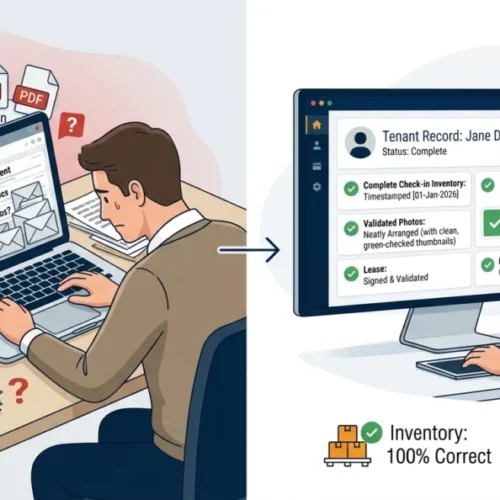
When you collect application data, identity documents, references, and move-in acknowledgments through a structured process, every submission is timestamped automatically and held in one place. If it ever becomes relevant, you can produce it quickly.
This is where structured data collection directly connects to deposit protection. A disorganised intake process at the start of a tenancy creates documentation gaps that surface as vulnerabilities at the end of it.
The Connection Between Data Collection and Deposit Disputes Documentation
Most landlords and agents think about deposit disputes as an end-of-tenancy problem.
The deposit disputes documentation that wins or loses a claim is almost entirely created at the start of the tenancy.
How you collect tenant documents, how you record the property’s condition, and how you confirm what was agreed all of this happens in the first few days. By the time a dispute arises, the evidence either exists or it does not.
A structured intake process, supported by consistent templates, means every submission is complete, timestamped, and organised from day one.
If your current process involves emailing PDFs and assembling replies from multiple threads, the records you end up with are not the records you want to be defending.
How GoPath Improves Deposit Disputes Documentation
GoPath is a structured data collection platform built for property managers and letting agents.
Instead of collecting tenant applications, ID documents, signed acknowledgments, and move-in information over email, you send one smart link. The tenant goes through a guided flow where required fields cannot be skipped.
Pre-built templates for applications, onboarding, and document collection ensure consistency across every submission.
When they submit, everything lands in one clean, organised dashboard, complete, timestamped, and ready to export.
If a deposit dispute ever arises and you need to produce deposit disputes documentation, that information is exportable in one click.
GoPath does not replace your inventory software or deposit protection scheme. It fixes the part of the process that those tools do not cover.
A Practical Checklist: Deposit Disputes Documentation
Before every tenancy begins, confirm the following are in place:
Check-in inventory
– Completed on or before move-in day
– Room by room, with photographs for every area
– Signed by the tenant and dated
– A copy given to the tenant with proof of receipt
Move-in documentation
– Tenant ID and right to rent documents collected and stored
– Signed tenancy agreement with dated execution
– Any agreed notes about existing damage recorded in writing
– Move-in acknowledgment signed and filed
Ongoing record management
– Any correspondence about property condition or maintenance is kept in a retrievable format
– Maintenance requests and responses logged with dates
– Any agreed changes documented in writing
Check-out process
– Tenant invited to be present
– Report completed as close to the move-out date as possible
– Compared directly to check-in inventory
– Any deduction decisions documented with specific references to evidence
Conclusion
Deposit disputes are rarely won or lost on the facts.
They are won or lost on the evidence — and evidence is created at the start of a tenancy, not at the end.
The landlords and agents who consistently protect their deposit claims are not necessarily the ones who have fewer disputes. They are the ones who built clean, complete, retrievable records from day one.
Messy data collection at move-in does not stay in the inbox. It becomes a weakness in your case when a dispute surfaces six months later.
The process you use to collect tenant information at the beginning of a tenancy is the foundation of your position if anything goes wrong at the end of it.
Frequently Asked Questions
What documentation do landlords need to win a deposit dispute? The most important documents are a detailed check-in inventory signed by both parties, a matching check-out report, and any correspondence about the property’s condition during the tenancy. Adjudicators give the strongest weight to signed, timestamped inventory reports that clearly show the property’s condition at the start of the tenancy. Without a check-in report, it is very difficult to justify deductions, even if the damage is real.
Why do landlords lose deposit disputes even when the damage is genuine? The most common reason is a lack of documented evidence that the damage occurred during the tenancy. If there is no signed check-in inventory, the landlord cannot prove the property was in a different condition when the tenant moved in. Adjudicators cannot award deductions based on the landlord’s word alone; they need documentation.
What is the burden of proof in a tenancy deposit dispute? In the UK, the burden of proof sits with the landlord or agent. The adjudicator begins from the position that the deposit belongs to the tenant. The landlord must demonstrate, using evidence, that a deduction is reasonable and justified. This is why documentation quality matters so much; the strength of your claim depends on the strength of your records.
Does collecting tenant documents properly help with deposit disputes? Yes. A complete, timestamped record of what the tenant submitted at move-in, ID documents, signed agreements, and move-in acknowledgments — supports your overall documentation position. It demonstrates that the tenancy was set up properly and that the tenant understood and agreed to the terms. When this information is collected in a structured, organised way rather than over email, it is easier to retrieve and produce as evidence if needed.
What is a structured data collection process for landlords? A structured data collection process means collecting tenant information — applications, identity documents, signed acknowledgments, and move-in forms — through a guided, controlled channel in which required fields cannot be skipped. Every submission is timestamped and stored in a single, organised record, rather than assembled from multiple email threads. This makes records easier to retrieve, easier to export, and more reliable as documentation if a dispute ever arises.