
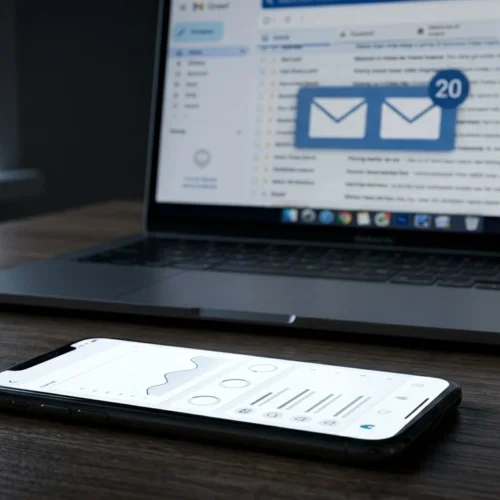
Email is not a bad tool. For communication, updates, and follow-ups, it works perfectly well. The problem is that most landlords and property managers have quietly turned it into something it was never designed to be: a document collection system, an application management platform, and an organizational filing system all at once.
And it fails at all three.
This article makes the case, plainly and specifically, for why collecting rental applications by email is holding your process back, what it is actually costing you, and what a better approach looks like.
How Email Became the Default for Rental Applications
It happened gradually and without much deliberate thought. Email was already being used to communicate with prospective tenants, so attaching an application form to an email felt like a natural extension of that. No new tools required. No learning curve. No cost.
The problem is that convenience at the start of a process often creates significant friction later. And in the case of email-based rental applications, that friction compounds with every additional applicant, every missing document, and every follow-up message sent into an already cluttered inbox.
Most landlords do not stop to question whether email is the right tool because the problems it creates are distributed across the process rather than concentrated in one visible failure. The wasted time is spread across a hundred small moments. The security risks are invisible until they are not. The organizational chaos feels like a normal part of the job rather than a symptom of a broken system.
It is not normal. It is just common.
The Real Problems with Collecting Rental Applications by Email
The Incomplete Application Problem
When you send a rental application form by email, you are trusting the applicant to read it carefully, complete every section, and return it with all required documents attached. In practice, this rarely happens.
Applicants skim. They miss sections. They attach the wrong document or an outdated one. They forget the reference letter and plan to send it separately. They misread the format requirements and send a photograph of a document instead of a scan.
Every gap in their submission becomes a follow-up email from you. Every follow-up email is time spent that should be spent elsewhere. And because you are managing multiple applicants simultaneously, these gaps pile up across different threads until your inbox becomes a disorganized repository of partial submissions from people whose names you have to search just to find their documents.
Required fields do not exist in email. Validation does not exist in email. The structure that prevents incomplete submissions simply cannot be built into an email workflow.
The Inbox Organization Problem
Picture a single vacancy that attracts ten interested applicants. Each one receives your application email. Each one sends back a reply, usually in multiple parts, over several days. Some send their payslips in one email and their ID in another. Some reply to the original thread. Some start a new one. References arrive from third parties with no context about which application they belong to.
By the end of the process, you have somewhere between thirty and fifty emails related to this one vacancy, spread across multiple threads, with documents attached to different messages and no reliable way to see at a glance who has submitted everything and who has not.
Now multiply that by the number of vacancies you are managing simultaneously.
This is not a minor inconvenience. It is an organizational system that is fundamentally unsuited to the task it is being asked to perform.
The Security and Compliance Problem
Rental application documents contain some of the most sensitive personal data you will handle. Passport numbers. Bank account details. National insurance or social security numbers. Employment records. Every time a tenant emails these documents to you, that sensitive data sits in an email inbox with no encryption, no access controls, and no defined retention policy.
Under GDPR in the UK, the Privacy Act in Australia and Canada, and applicable data protection regulations in the US and UAE, landlords are legally responsible for the secure handling of applicant personal data. That responsibility does not disappear because the data arrived via email rather than a structured secure platform.
If your email account is compromised, every document submitted by every applicant in your history is exposed. If you forward an application to a co-owner or letting agent, you are sharing sensitive personal data through an uncontrolled channel. If you keep old applications indefinitely in your inbox because it is easier than deleting them, you are holding data beyond the period justified by your original collection purpose.
None of this is theoretical. It is a real and growing area of legal exposure for landlords who have not updated their document handling practices.
The Slow Turnaround Problem
In competitive rental markets, speed matters. A strong tenant who is seriously looking will often be weighing up multiple properties simultaneously. Every unnecessary delay in your application process is an opportunity for them to accept an offer elsewhere.
The traditional email application workflow is full of unnecessary delays. The applicant has to download the form, fill it in, scan or photograph their documents, and send everything back. Each step is friction. For mobile users, the friction is even greater. Only around a third of people own a scanner, meaning the rest have to find a workaround just to return a completed application.
Then there is the delay on your end. Before you can even review an application, you have to locate all the documents across multiple email threads, confirm nothing is missing, and organize everything into a reviewable format. That process alone can take 20 to 30 minutes per applicant.
A well-structured online application that takes 10 minutes for a tenant to complete and arrives organized in your dashboard is not just more convenient. It is genuinely faster for everyone involved.
Why Email Is the Worst Way to Collect Rental Applications at Scale
Every problem above is manageable when you have one or two properties and a handful of applicants per year. But even at that scale, the inefficiencies are present. As your portfolio grows, they multiply.
A property manager handling 15 active listings cannot afford to manage 150 emails per vacancy cycle across an inbox that was never designed for structured data collection. The process does not just become annoying at scale. It becomes genuinely unsustainable.
This is why the landlords and agents who grow their portfolios most successfully are almost always the ones who replace email-based workflows with structured digital systems early, rather than waiting until the chaos forces the change.
What a Better Way to Collect Rental Applications Looks Like
The alternative to email-based applications is not complicated. It is simply a structured digital form that collects all required information and documents in one organized submission.
Here is what that looks like in practice.
You build your rental application form once, covering every field and document you need. You save it as a reusable template. When a property becomes available, you send every interested applicant a single link to that form. They complete it on their phone or laptop, upload their documents directly into the form, and submit everything in one go.
Required fields mean incomplete applications cannot be submitted. Structured inputs mean documents arrive organized by field rather than scattered across email attachments. A dashboard shows you every application in one place, with clear visibility into who has submitted, who is still outstanding, and what each submission contains.
No inbox management. No manual organization. No chasing.
GoPath is built precisely for this workflow. Landlords and property managers use it to create reusable application templates, collect structured submissions from multiple applicants simultaneously, and manage everything from a single organized dashboard. At $20 a month, the time saved on a single vacancy cycle covers the cost many times over.
Email vs. Structured Digital Application: A Direct Comparison
| What Matters | Digital Form | |
| Completeness | Applicants frequently miss fields | Required fields prevent incomplete submissions |
| Organization | Documents scattered across threads | All submissions organized in one dashboard |
| Security | Sensitive data in unencrypted inbox | Encrypted storage with access controls |
| Speed for applicant | Print, fill, scan, email back | Complete and submit on any device in minutes |
| Speed for landlord | Manual compilation before review | Organized submission ready to review immediately |
| Scalability | Breaks down quickly at volume | Handles multiple applications simultaneously |
| Reusability | New email each time | One template reused across every vacancy |
| Compliance | No audit trail, no retention controls | Structured storage with defined access and retention |
Common Objections, Answered
“My tenants are not tech-savvy enough for an online form.”
A well-designed digital application form is easier to complete than downloading, printing, filling in, scanning, and emailing back a PDF. If a tenant can use a smartphone to browse a rental listing, they can complete an online application. The barrier is lower than most landlords assume.
“I have been doing it this way for years and it works fine.”
Fine is not the same as good. Most landlords who have switched to structured digital applications describe the experience as immediately and obviously better. The improvements are not marginal. They are the kind that make the old process feel inexplicable in retrospect.
“Setting up a new system takes time I do not have.”
Setting up a GoPath application template takes less time than the follow-up emails generated by a single incomplete application submitted by email. The upfront investment is measured in minutes. The ongoing time saving is measured in hours per vacancy.
“Email gives me a paper trail.”
A scattered, unorganized email thread is a poor substitute for a structured audit trail. A digital application platform gives you a complete, timestamped record of every submission, every document, and every interaction, organized by applicant and searchable at any time.
Frequently Asked Questions
Is collecting rental applications online secure?
Yes, provided you use a platform with encrypted storage and controlled access. Online collection is significantly more secure than email, where sensitive documents sit in an unencrypted inbox indefinitely with no access controls.
Can I still use email to communicate with applicants if I collect applications digitally?
Absolutely. Using a digital form for structured data collection does not replace email communication. It simply removes email from the role it was never designed to fill, which is document management and application tracking.
Do tenants need to create an account to submit a digital application?
With GoPath, no. Recipients can fill in and submit a form without creating an account, which removes a common barrier to completion and keeps the process frictionless for applicants.
How do I handle applicants who are not comfortable with technology?
In practice, this concern comes up far less often than landlords expect. A well-designed form on a smartphone is intuitive for most people. For genuinely non-technical applicants, a brief phone call walking them through the process takes five minutes and is still considerably faster than the email-based alternative.
Is a digitally submitted application legally valid?
Yes. Digital submissions with electronic consent are legally valid across the UK, US, Canada, Australia, and UAE. Digital forms often provide a stronger legal record than paper applications because they include timestamps, IP addresses, and structured data that is difficult to dispute.
The Honest Conclusion
Email is not going away, and it should not. As a communication tool, it remains essential. But as a rental application management system, it was always a workaround, not a solution.
The landlords and property managers who are making the fastest progress, filling vacancies quickly, maintaining clean records, and scaling their portfolios without scaling their admin load, are almost universally the ones who have stopped treating their inbox as a filing system.
The switch is not difficult. The tools are straightforward, affordable, and designed specifically for this problem. What is genuinely difficult is continuing to manage the chaos of an email-based process when a better option is sitting right there.
GoPath is that option. One form. One link. One organized dashboard. Everything you need to collect, review, and manage rental applications without opening your email once.
Get started with GoPath from $20 a month