
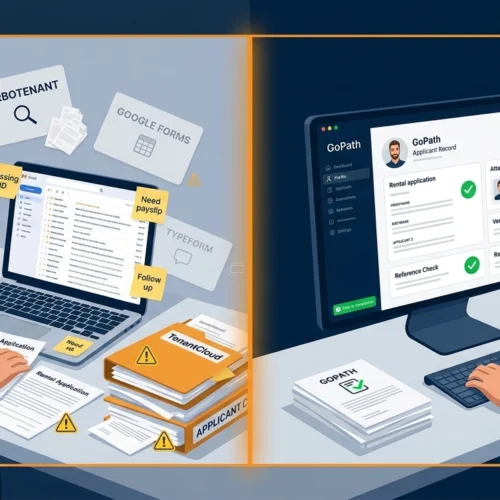
The right rental application form software does one job above everything else.
It gets you a complete application, every required field filled, every document attached, every submission timestamped and retrievable, without you having to chase anyone for the rest of it.
That sounds straightforward. In practice, most small property managers are still not there.
According to Buildium’s 2026 Property Management Industry Report, 91% of renters now prefer to complete at least part of the leasing process online. The demand for digital applications is there. The gap is in how well those applications actually collect what is needed, and what happens to the data afterwards.
This comparison covers the best rental application form software options available to small and independent property managers in 2026. Not enterprise suites built for 200-unit portfolios. Not tools that require a development team to configure. Practical tools for operators running between one and fifty properties who need applications to come back complete, organised, and usable from day one.
What Small Property Managers Actually Need From Application Software
Before comparing tools, it is worth being specific about what this category of operator actually needs, because it is different from what enterprise buyers need.
Small property managers and independent letting agents typically share a few characteristics. They manage between one and fifty properties. They do not have a dedicated admin team. They are often one or two people doing the work of a full office. And they have almost certainly been managing applications through email, PDFs, and spreadsheets for longer than they would like to admit.
For this audience, the criteria that matter most are:
Completion enforcement. Does the tool prevent incomplete submissions, or does it just hope applicants fill everything in? For a small operator without time to chase, this is the most important criterion.
Ease of setup. Can it be configured and live within an hour, with no technical knowledge? Tools that require onboarding calls and IT setup are not designed for independent operators.
Cost. Most small operators do not need rent collection, maintenance tracking, and accounting bundled into the same platform. Paying £100 to £200 per month for features you do not use is not a trade-off worth making for the application collection layer alone.
Record quality. Can you retrieve a specific applicant’s complete submission six months later, quickly, cleanly, and with a clear timestamp, if a dispute or compliance check requires it?
Portability of data. Can you export everything in a format that works with the rest of your workflow?
Every tool below is evaluated against these criteria. Not against whether it offers integrated accounting or AI maintenance dispatch, features that matter for large operations but are irrelevant for someone managing a small portfolio from a laptop.
The Tools Compared
1. TurboTenant
Best for: Individual landlords in the US who want a free starting point with basic online application features.
TurboTenant is one of the most widely used free property management platforms for small landlords in the US market. Its free plan includes online rental applications, tenant screening (credit, background, and eviction checks), basic lease management, and rent collection.
The application feature allows landlords to create a listing and send applicants a link to complete a standardised form. Responses feed into a dashboard where the landlord can review and compare applicants.
Where it works well: The free tier is genuinely useful for landlords with a small number of units who need a centralised place to receive applications. The interface is clean, and the screening integration is well built. For small landlords managing fewer than 50 units, TurboTenant is one of the strongest free options available, covering rent collection, tenant screening, maintenance tracking, and basic accounting in one place.
Where it falls short: TurboTenant’s application form is designed primarily as a screening intake tool; it collects information for the purpose of running credit and background checks. The document collection layer (payslips, ID, proof of income, right to rent) is not the platform’s strength. Customising the form to enforce specific required fields and prevent incomplete submissions requires a Premium plan.
TurboTenant’s pricing starts with a Premium plan that costs $12.42 per month, billed annually, and unlocks customisable applications. At that tier, it becomes more capable, but the document upload and enforcement functionality still does not match what dedicated collection tools offer.
Pricing: Free tier available. Premium from $12.42/month (US only).
Verdict: Strong free option for US landlords who primarily need screening. Less suited for operators who need enforced document collection and retrievable submission records.
2. Avail
Best for: Small independent US landlords who want an end-to-end platform with a free starting point.
Avail is a Realtor.com company offering property management tools for independent landlords. Its free plan includes rental listings across multiple sites, tenant applications, basic screening, rent collection, and expense tracking.
The application process is straightforward: landlords publish a listing, applicants apply through a standardised form, and results appear in a dashboard for review.
Where it works well: Avail helps landlords reduce administrative tasks and is designed specifically for small-scale and independent landlords, offering tools, support, and education to help beginner landlords succeed. The free tier is genuinely comprehensive for what it includes.
Where it falls short: Like TurboTenant, Avail’s application tool is built around the screening process. Document collection, the gathering of proof of income, identification, and tenancy history in a structured, enforceable way, is not a primary feature. The platform does not enforce document completeness at submission, which means follow-up remains part of the process for any operator collecting more than basic form responses.
Pricing: Free plan available. Unlimited Plus at $9/unit/month.
Verdict: Good free option for small US landlords who want rent collection and screening in one place. Not the strongest choice for operators whose primary pain is incomplete document submissions.
3. TenantCloud
Best for: Budget-conscious small landlords who want a broad feature set at low cost.
TenantCloud offers a free plan covering up to 75 units, with paid plans starting at approximately $15.60 per month. It includes online rent collection, maintenance request management, rental applications and leasing, expense tracking, accounting, and property marketing.
The application feature sends applicants to an online form that collects standard information and can be connected to screening services.
Where it works well: The free plan is generous, and the breadth of features at the paid tier is strong for the price. For landlords who want a single platform covering most operational tasks without paying enterprise prices, TenantCloud is a reasonable option.
Where it falls short: The interface is not as intuitive as competitors, according to user reviews, which creates friction for operators who need to onboard quickly. The application form does not enforce document completeness; incomplete submissions remain possible and common. For small teams where chasing is the primary pain, TenantCloud reduces some admin but does not eliminate the follow-up cycle.
Pricing: Free for up to 75 units. Paid plans from $15.60/month.
Verdict: Broad feature set at a competitive price. Not purpose-built for enforced document collection.
4. Google Forms
Best for: Operators who need a zero-cost starting point and are comfortable assembling their own process.
Google Forms appears in this comparison because a significant number of small property managers and independent letting agents currently use it, not because it is purpose-built for rental applications.
It is free, instantly familiar, and integrates directly with Google Sheets. For operators who have set up a well-structured form with clear instructions, it can collect basic application information reasonably well.
Where it works well: Zero cost, zero setup time, works within tools most people already use daily.
Where it falls short: Google Forms was designed for surveys and feedback, not compliance-critical document collection. Required fields can be configured, but cannot prevent a determined submitter from bypassing them. There is no document upload validation. Responses aggregate into a spreadsheet row rather than a per-applicant record with attached documents. If the Google account tied to the form is lost or the storage limit is reached, new submissions stop coming through without warning.
For a full breakdown of how Google Forms compares to purpose-built collection tools, see the guide on email vs online forms vs structured workflows.
Pricing: Free.
Verdict: Adequate for informal, low-stakes collection. Not appropriate for operators who need enforced completeness, audit-ready records, or reliable document uploads.
5. Typeform
Best for: Operators who want a polished applicant experience and are primarily collecting information rather than documents.
Typeform’s conversational, one-question-at-a-time interface produces measurably higher completion rates for survey-style forms. Some letting agents use it as an initial pre-qualification tool before requesting full documentation.
Where it works well: The applicant experience is genuinely better than most alternatives. Completion rates are higher. The forms feel professional and modern.
Where it falls short: Typeform is a survey and lead generation tool. Its required field enforcement can be bypassed in some configurations. File uploads require a paid plan. Monthly response caps mean a busy application period can hit the limit mid-process. For operators who need document uploads alongside form responses in a single enforced flow, Typeform’s architecture is not designed for this use case.
Pricing also escalates quickly. The entry point for a usable Typeform plan with branding removal and adequate response volume is typically $50 to $83 per month, significantly more than the headline $29 rate suggests.
Pricing: From $29/month. The effective cost for operational use is typically $50 to $83/month.
Verdict: Strong for engagement and pre-qualification. Weak for enforced document collection and operational record-keeping.
6. GoPath
Best for: Small property managers and letting agents who need every application to come back complete, with a retrievable, timestamped record, without paying for a full property management suite.
GoPath is a structured data collection platform built specifically for operational collection scenarios. It was designed for the gap that every other tool in this comparison leaves open: getting complete, structured, document-inclusive applications from multiple applicants simultaneously, with no chasing required.
How it works: You select a template from GoPath’s library of premade rental application forms, covering everything from basic tenant applications to full tenancy onboarding packs, customise it if needed, and share a single smart link with applicants. They go through a guided submission flow where required fields cannot be skipped, and documents cannot be partially attached. The submission either goes through completely or it does not go through at all.
Every submission lands in a clean dashboard, organised by applicant, with full timestamps and attached documents preserved. All data is exportable to CSV in one click.
Where it works well:
Completion enforcement is the primary differentiator. Unlike every other tool in this comparison, GoPath makes incomplete submissions structurally impossible rather than merely discouraged. This eliminates the follow-up cycle for operators who have built their working week around chasing what did not come back properly.
The template library removes the setup burden. There is no building from scratch; premade forms for rental applications, tenant onboarding, move-in documentation, and contractor compliance are ready to use immediately.
The record quality is purpose-built for retrieval. Each applicant’s submission is stored as a standalone record with a timestamp, not a spreadsheet row, which means producing a specific applicant’s complete file months later takes seconds rather than an email inbox search.
For a complete guide to how application collection fits into the broader leasing process, see GoPath’s guide on how to streamline the listing-to-lease process.
Where it falls short: GoPath does not include rent collection, maintenance tracking, tenant screening, or accounting. It solves one specific problem: getting complete, structured documents from people, rather than trying to be a full property management platform. Operators who need those additional features will need to pair GoPath with another tool or use one of the full-suite options above.
Pricing: £20 / $20 per month flat. No response caps. No feature tiers. No contracts.
Verdict: The strongest option in this comparison is specifically for enforced document collection and audit-ready records. Not a full property management suite, and deliberately so.
Side-by-Side Comparison
| Tool | Enforces completeness | Document uploads | Audit-ready records | Monthly cost | Free tier |
|---|---|---|---|---|---|
| TurboTenant | Partial (Premium) | Limited | Basic | From $12.42 | Yes |
| Avail | No | Limited | Basic | From $9/unit | Yes |
| TenantCloud | No | Limited | Basic | From $15.60 | Yes (75 units) |
| Google Forms | No | Basic | No | Free | Yes |
| Typeform | Partial | Paid plan only | No | From $50+ effective | No |
| GoPath | Yes, hard gate | Yes, guided flow | Yes, per-applicant | £20 / $20 flat | No |
Which Tool Is Right for Your Situation?
If you are a US landlord just getting started with fewer than 10 units and your primary need is screening, TurboTenant’s free tier covers the basics well. Start there and upgrade when the limitations become painful.
If you want a free all-in-one platform for a small US portfolio, Avail is the strongest free option across the widest range of features. Understand that the application collection layer will still require manual follow-up for incomplete submissions.
If budget is your primary constraint and you manage under 75 units, TenantCloud’s free plan is generous. Accept that the interface has a steeper learning curve than the competition.
If you already have a property management platform and just need the application collection layer to actually work, GoPath slots in alongside whatever you already use. It solves the specific problem, enforces completeness, clean records, and no chasing, without replacing anything.
If incomplete applications and document chasing are costing you meaningful time every week, this is the problem GoPath was built for. At £20 / $20 a month with no setup time and a ready-to-use template library, it is worth trying before spending more on a full-suite platform that leaves this problem unsolved.
What to Look for Before You Choose
Before committing to any rental application form software, test it against these four questions.
Can applicants submit an incomplete form? Open the form yourself. Leave a required field blank. Try to submit. If it goes through, your process still depends on manual checking and follow-up. That is the time you are trying to protect.
Where does the data live? Is it in a dashboard you control independently, or tied to a personal account that could create access problems if circumstances change? Can you retrieve a specific applicant’s file quickly without searching?
What does the export look like? Download the data. Is it a clean, structured CSV with attached documents preserved, or a flat spreadsheet of form responses with documents scattered elsewhere? The export quality determines how useful the data is downstream.
What does setup actually require? Create an account and try to go live with a real form. If you cannot send a first smart link within 30 minutes without reading a manual, it is not the right tool for a one-person operation.
Conclusion
The best rental application form software for small property managers in 2026 is the one that solves the actual problem, not the one with the most features.
For most independent operators and small agencies, the problem is not a lack of rent collection tools or maintenance tracking. It is that applications come back incomplete, documents arrive scattered across email threads, and too much of the working week disappears into chasing the rest.
The tools that address this specifically, rather than wrapping it inside a full management suite, are the ones worth evaluating first. At £20 / $20 a month flat with no response caps and enforced completeness built in from the start, GoPath is the most direct solution to this specific problem available to small operators in 2026.
See how GoPath works at getgopath.com
Frequently Asked Questions
What is rental application form software? Rental application form software is a tool that allows landlords and property managers to collect structured information from prospective tenants digitally, replacing paper forms, PDFs, and email-based collection. The best tools enforce completeness at submission, store records in an organised dashboard, and allow data to be exported in a usable format. For small operators, the key criteria are ease of setup, cost, and whether the tool prevents incomplete submissions.
What is the best free rental application software for small landlords? TurboTenant and Avail are the strongest free options for US-based small landlords. Both offer online application forms, tenant screening, and basic rent collection at no cost to the landlord. The limitation of both free tiers is that they do not enforce document completeness; incomplete applications can still be submitted and will require manual follow-up. For operators where chasing incomplete applications is the primary pain, a purpose-built collection tool like GoPath at £20 / $20 per month is likely to save more time than the free alternative costs.
Do I need full property management software or just an application form tool? It depends on your operation. Full property management software, such as Buildium, AppFolio, and TurboTenant, covers rent collection, maintenance, accounting, and applications in one platform. This is valuable if you need all of those features and are willing to pay for them. If your specific problem is that applications come back incomplete and document collection is eating your time, a focused tool that solves that one problem is more cost-effective than a full suite where the application layer is a secondary feature.
How can I stop receiving incomplete rental applications? The only reliable way to prevent incomplete submissions is to use a collection tool that enforces completeness at the point of submission, where required fields are hard gates rather than soft reminders. Email, PDF forms, and standard form builders like Google Forms do not enforce completeness in this way. Tools like GoPath are built specifically to make incomplete submissions structurally impossible: the form cannot be submitted until every required field is filled and every required document is attached.
What should a rental application form include? A standard rental application form should collect personal information, including full name, date of birth, and address history for the past two to three years; employment details and proof of income; references from the current employer and most recent landlord; identification documents; and right to rent documentation in the UK or authorisation for credit and background checks in the US. For a complete breakdown of what to collect and why each field matters, see GoPath’s free rental application form template guide.
Is GoPath a full property management platform? No. GoPath is a structured data collection platform that solves one specific problem: getting complete, structured documents and applications from multiple people simultaneously, with enforced required fields, centralised records, and one-click CSV export. It does not include rent collection, maintenance tracking, tenant screening, or accounting. It is designed to complement existing workflows rather than replace a full property management system.