
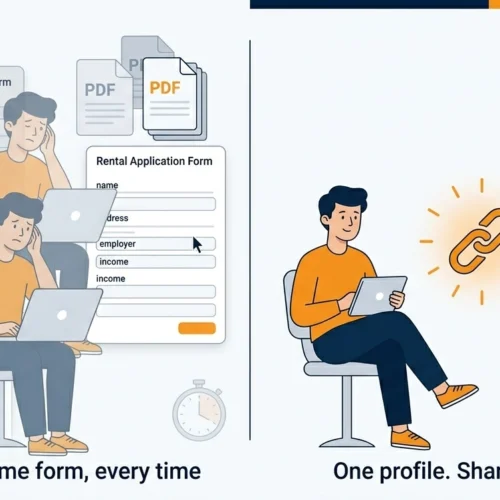
If you are applying to multiple rental properties right now, you most likely already know how it works.
You find a flat or apartment you like, request an application, and then spend 20 minutes filling in the same information you already filled in for the last one. Your full name. Date of birth. Current address. Previous address. Employer. Monthly income. References. Emergency contact.
Then you do it again for the next one, and the next, and yes, the next one as well.
By the time you have submitted to three or four properties, you have typed your employer’s phone number so many times you can recite it in your sleep, and you are still not sure which application will come back with a yes.
This is one of the most frustrating parts of renting that nobody talks about enough, and it is almost entirely avoidable.
This guide explains what to prepare, how to organise it, and how to make applying to multiple rental properties significantly faster without sacrificing the quality of your application.
Why Applying to Multiple Properties Is the Right Strategy
First, a quick note on why applying to more than one property at a time is not just acceptable, it is often the smartest approach.
In competitive rental markets, a single application is a significant risk. According to a Zillow consumer trends report, 66% of renters submitted two or more applications in 2023. In high-demand cities, multiple applicants often compete for the same unit within hours of it being listed.
Applying to multiple properties simultaneously protects you. It means you are not dependent on one outcome while your timeline ticks down, whether you are relocating for work, coming off an expiring lease, or simply trying to move before prices go up further.
The problem is not the strategy. The problem is the process most renters use to execute it, which currently means starting from scratch every single time.
What Agents and Landlords Actually Ask For
Before you can prepare your information properly, it helps to understand what you will be asked for across most applications. While every landlord and agent has slightly different requirements, the core information is almost always the same.
Personal information
- Full legal name
- Date of birth
- Current address, and how long you have lived there
- Previous address or addresses covering the last two to three years
- Contact number and email address
- Right to rent documentation (UK) or government-issued ID (US and internationally)
Financial information
- Employment status and employer name
- Monthly or annual income
- Proof of income, payslips, bank statements, or tax returns, depending on the landlord
- If self-employed: additional proof such as a tax return or accountant’s letter
References
- Employer reference: name, role, contact details for someone who can confirm your employment and income
- Previous landlord reference: contact details for your most recent landlord or letting agent
- Personal or character reference, in some cases
Additional documents
- Identification: passport, driving licence, or national ID
- In the UK: proof of right to rent (passport or settled status documentation)
- In the US: Social Security Number for credit check authorisation
- In some cases, a cover letter or short personal introduction
Most letting agents and property managers will ask for variations of this list. Understanding it up front means you are never scrambling for something you did not expect.
The Preparation Step Most Renters Skip
The majority of renters approach each application the same way: find a property, get the form, fill it in, repeat.
The more effective approach is to treat your application information as a document you prepare once, thoroughly and carefully, and then deploy wherever it is needed.
This preparation step takes thirty to sixty minutes the first time. After that, every subsequent application takes a fraction of the time because the information is already ready.
Here is what that preparation looks like in practice.
Build a digital document folder
Create a folder on your computer, in cloud storage, or in an app you already use that contains everything you might be asked for.
Include scanned or photographed copies of:
- Your photo ID (passport or driving licence)
- Your most recent payslip or proof of income
- Your last two to three months of bank statements, if you are self-employed or your income varies
- Your right to rent documentation if you are applying in the UK
- Any reference letters you already have
Keep the folder updated. If your payslip changes or your address history becomes relevant again, update the documents so you always have a current version ready.
Draft your reference contact details once
Write out the full contact details for your employer reference and your previous landlord reference, name, role, organisation, email, and phone number, and save them somewhere easily accessible.
You will be asked for these in almost every application. Having them typed out in advance means you are never hunting for a phone number mid-form.
Write a short tenant introduction
Many letting agents and private landlords respond well to a brief personal introduction, two to three sentences about who you are, why you are moving, and why you would be a good tenant. This is not always asked for, but including it voluntarily can set your application apart from a pile of identical forms.
Draft it once. Adjust it slightly for each property if needed. But the core of it should be ready to copy in.
How to Apply to Multiple Properties Without the Chaos
With your information prepared, applying to multiple properties becomes significantly more manageable. Here is a practical approach for keeping things organised.
Keep a tracking list
Once you are applying to more than two or three properties simultaneously, it becomes easy to lose track of what you have submitted, where you are in the process, and who you are waiting on.
A simple list, even a basic spreadsheet, with the following columns removes the confusion:
- Property address and listing link
- Agent or landlord name and contact details
- Date application submitted
- Documents included
- Current status
- Next follow-up date
This takes five minutes to set up and saves significant mental load over the course of an active property search.
Apply to properties you are genuinely interested in
It can be tempting to submit applications broadly to maximise your chances. The more targeted approach is usually more effective.
Each application takes time and, in many cases, money. Application fees in the US typically range from $25 to $100 per property. Even where fees are lower, the administrative burden of managing ten simultaneous applications is significant.
Apply to properties you would genuinely accept if offered. This keeps your search focused and your application quality high.
Move quickly on strong leads
In a competitive market, speed is one of the main variables you can control.
If you have viewed a property and you are seriously interested, submit your application the same day, where possible, ideally with a complete set of documents rather than promising to send things across later. A complete, well-organised application submitted promptly is more competitive than a partial one submitted first.
This is one of the areas where having your information pre-prepared makes the biggest difference. If your documents are already in a folder and your reference details are already written out, you can submit a complete application within an hour of viewing.
The Bigger Problem: Why This Process Is Harder Than It Should Be
Even with thorough preparation, applying to multiple properties still involves a significant amount of repetition. You are rebuilding the same submission, in different formats, for different agents who all want essentially the same information.
The underlying issue is that the rental application process was not designed with the renter in mind. It was designed for agents and landlords to collect what they need, and each one collects it in their own way, on their own form, through their own process.
The result is that renters end up as data entry clerks for their own housing search.
This is starting to change. California’s AB 2559 and similar legislation in other US states have begun to formalise the concept of a portable screening report, a standardised application that a renter can complete once and share with multiple landlords, reducing the repetition and the cost of multiple application fees.
The broader idea, building your information once and sharing it wherever it is needed, makes intuitive sense to anyone who has been through a competitive rental search.
A Better Way: Build Your Renter Profile Once and Share It
The most efficient version of this process is one where you create your applicant information once, everything an agent would need, organised clearly, in a structured format, and share it with any agent or landlord who asks.
This is what GoPath makes possible for renters.
Instead of filling in a new form for every property, you build a single smart form containing all the information you know agents will ask for. You populate it once with your personal details, employment information, references, income confirmation, and any supporting notes. GoPath’s template library includes premade renter profile formats so you are not starting from a blank page.
When you find a property you want to apply for, you share your GoPath link with the agent. They receive a clean, complete, structured submission, everything in one place, nothing missing.
You do not fill in another form. You do not assemble the same documents again. You share a link.
For agents and letting agents, receiving a structured, complete application from a renter who has clearly prepared is a signal that the applicant is organised and serious. Agents who deal with incomplete applications all day will notice when one comes in that is already complete and well-presented.
That impression matters more than most renters realise. If you want to understand exactly what letting agents look for in an application, GoPath’s guide to what letting agents look for in an application covers the full picture from the agent’s side.
And if you want to see what a standard rental application form actually contains before you prepare yours, the rental application form guide on GoPath’s blog covers every field in detail.
Getting started is free. There are no application fees. You build your profile once and share it as many times as you need.
Create your renter profile at getgopath.com
Rental Application Documents Checklist
Use this as a reference when preparing your information folder before you begin applying.
Identity
- Passport or government-issued photo ID
- Driving licence (as secondary ID where required)
- Right to rent documentation (UK applicants)
Employment and income
- Most recent payslip (or last two to three if income varies)
- Employment contract or letter confirming your role and salary
- Bank statements for the last two to three months
- If self-employed: most recent tax return or accountant’s letter
References
- Employer reference contact details (name, organisation, email, phone)
- Previous landlord reference contact details
- Personal reference contact details if requested
Rental history
- Previous address history for the last two to three years
- Any letters of good standing from previous landlords, if available
Additional
- Short tenant introduction (optional but useful)
- Pet information, if applicable
- Any relevant notes about your moving timeline or circumstances
Conclusion
Applying to multiple rental properties does not have to mean filling in the same form over and over from scratch.
The renters who move through a competitive search most efficiently are the ones who prepare once and apply quickly, with a complete, organised set of documents ready to share the moment they find something worth pursuing.
Build your information once. Keep it updated. And find a way to share it that gives agents everything they need without putting you through the same repetitive process every time.
That is the smarter way to apply.
Frequently Asked Questions
Is it okay to apply to multiple rental properties at the same time? Yes. Applying to more than one property simultaneously is a common and practical approach in competitive rental markets. Most landlords and letting agents understand that renters are protecting themselves against uncertainty. You are under no obligation to disclose that you are applying elsewhere, though you should withdraw your application promptly if you accept another offer.
What information do I need for a rental application? Most rental applications ask for your personal details, including name, date of birth, and address history; employment information and proof of income; references from your employer and previous landlord; and identification documents. In the UK, you will also need the right to rent documentation. Having all of this prepared in advance makes it significantly faster to apply when you find a property you want.
Why do I have to fill in the same information for every property I apply to? Because the rental application process was designed around what landlords and agents need to collect, not around the renter’s experience. Each agent or landlord has their own form, their own process, and their own format, which means renters end up re-entering the same information repeatedly. Tools like GoPath allow renters to build their information once in a structured format and share it as a link, removing most of the repetition.
What is a reusable or portable rental application? A portable rental application is a version of your applicant information that you complete once and can share with multiple landlords or agents. Some versions, like those introduced under California’s AB 2559, are specifically structured around credit and background check reports. Others, like a GoPath renter profile, cover the full set of information agents ask for: personal details, employment, references, income, and supporting documents.
How can I make my rental application stand out? Submit a complete application immediately after viewing a property you are interested in. Include all required documents without waiting to be chased for them. Add a brief personal introduction if the agent or landlord seems open to it. Agents who review many incomplete or disorganised applications consistently remember the ones that arrive ready to review. Completeness and speed are your two biggest competitive advantages as a renter.
How does GoPath help renters applying to multiple properties? GoPath allows renters to create a structured renter profile containing all the information agents typically ask for. You build it once using a premade template from GoPath’s template library, populate it with your details and documents, and share it via a single link with any agent or landlord you apply to. There are no application fees to pay through GoPath, and no limit on how many times you can share your profile. Agents receive a clean, complete submission, and you avoid filling in the same form from scratch every time.